Tuesday, February 28, 2012

Paper Clay Results

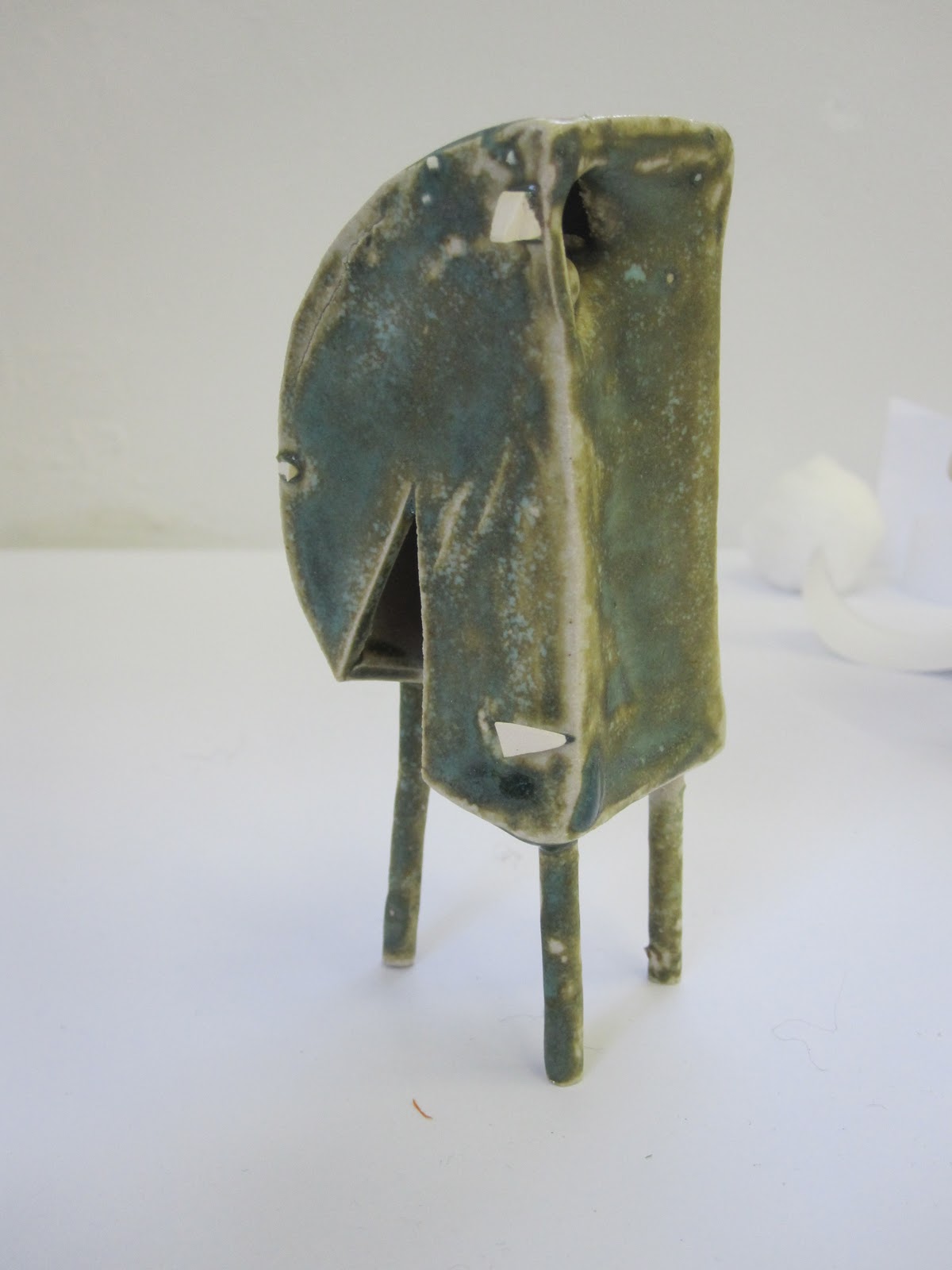
Here are the results from my first paper clay firing:


 Putting a cardboard cone in the paper clay seems to support it enough for the firing, the cones without supports collapsed and the ones with wire frames looked to bulky, so I'm going to stick with the card supports for now. I like the simplicity and delicacy of these pieces, I need to work on the shapes more to find some that get across a sense of protection and care, at the moment some of these pieces seem more like flowers than anything else! I also need to work on the finish and experiment with the clay more, to try and see what I can really get out of it and how far I can push it to get the results I want.

Tuesday, February 21, 2012

Paper Clay

After looking at the work I had done last semester, I tried to figure out what approaches were working and which weren't. I set criteria for myself for how I wanted the work to be, to help me make some decisions. I really admire simple, clean, well made pieces, so I decided so leave the 'furniture' like work I had been making, and try get my concept across in a clearer manner with simple, abstract shapes.


I made some simple paper maquettes to try and make my ideas 3D, and see where I might run into problems.


The paper models looked well, and had something of that clear, clean property that I admire so much in other people's work. I want to keep the slightly fragile look of these pieces, the paper makes them look a lot less solid and strong than thick clay walls, yet the shape of the pieces still retains that feeling of trying to protect something by putting it out of reach, or hiding it away. I decided to experiment with some paper clay models, to try and get the height I wanted in my pieces and still keep that wafer thin form. I havn't worked with paper clay much before, so I'm experimenting with different types of supports and construction to see what results I will get when they are fired.
 porcelain paper clay, no supports
 porcelain paper clay, resting on cardboard cone
 paper clay cones, attached with slip
paper clay, rolled with sheet of card inside
 paper clay, no support
 selection of tubes, some attached with slip
paper clay cone with wire and string support

 When this first batch are fired I will be able to look at them and see where to go from there in order to support the pieces better. It seems a little odd to build them with supports which I am fairly certain won't work, but it will give me a better idea of how the clay works, and what it needs in order to remain standing.

Tuesday, January 24, 2012

End of first semester

The work that I produced at the end of this semester was mostly maquettes, as I am still experimenting with how to get  across my idea at this point in time.


 These pieces, although I find them interesting do not provide a satisfactory solution for me, especially when I increased the scale, such as below. I felt that they instantly lost the awkward fragility that they had when smaller and no longer portrayed an idea at all.


I have lots of new ideas for this project now. The pieces I have been working on in clay are not strong enough at present, and I have go back and question why I make them the way I do, and then try to push my ideas further to make my work clearer.

Thursday, December 29, 2011

Maquettes 2

I have been focusing on mainly one aspect of my model making for the last while. I like the idea of making objects in my attempt to convey a sense of protection and care. The original model I made came from the idea of putting something up high, out of reach on a shelf. I have been experimenting with shapes and arrangement to get a sense of vulnerability into the pieces, and see how I can make them get the ideas across clearer.


Thursday, November 24, 2011

Maquettes

I had been working around the idea of repairs for some time, and I found when I looked back over my research, that the objects themselves seemed to be getting in my way. I find the care that people give to very ordinary, unimportant objects fascinating, and I want to try and express that in my work. People pack pictures and postcards away in boxes so they don't become damaged, precious tableware goes in a display case or up on a very high shelf, an old coat that seems very ordinay is repaired instead of buying a new one. Objects serve as symbols and reminders of people, places and memories and we care for them accordingly, making sure they don't become broken or lost, and finding or fixing them when they do.
It is this feeling of care and protection of a small, non-essential item that is the most interesting point of my research, and I am attempting to express that. By taking the specific objects out of the story, and working with simpler, more abstract shapes I find that the feeling comes across more, instead of the viewer becoming distracted by why each object specifically was chosen. I have been playing around with different ideas to see how best to get this across.


I'm looking at the scale and thickness of the shapes aswell, a thick wall can denote something very different from a paper thin one; as can scale and repitition. There is a lot more experimenting to be done, and I think I could get some great results if I really push this far enough.

Sunday, October 23, 2011

Repairs 2

Since my last post I have moved on quite a lot in my project. I reviewed my work to date, and I felt that although the reassembled toys were interesting, they didn't really get the point I wanted across, and their main factor was in shock value rather than repairing things. I felt that the ceramic pieces had more to them, so I tried to keep reassembling them, trying to see how much I could do with the different shapes of the broken crockery.


It seemed a little bit unsure, and lacking direction, so I looked at these models and tried to re-asses my project, and what I was trying to say with it. I realised that what I was trying to get across from this breaking and assembling of objects was the importance that people place in very every-day, mundane objects. Something that is a gift or has a memory attached to it will be treasured in a way more expensive items may not. I hope to research this idea more and find a way to show how people can treasure very simple, ordinary items.
I started thinking about ways to try and convey this idea of ordinary things becoming very important, and I looked into the historical aspects of this. I noted how japanese culture respects the ordinary, and how they find beauty in the most simple, functional vessels for their tea ceremonys. I don't want to use this directly in my project as it is full of so much history that I really don't have the knowledge to comment on, but I liked that idea of beauty in functionality; and wanted to try and apply it to a more western, modern culture. I decided upon looking at a plastic cup, as it is entirely functional and no part of it is intended to do anything other than act as a temporary vessel. I have started investigating how to create a sense of importance when you look at this object, and think exploring this path more could lead to some really interesting results.


By changing the environment, size, or material the cup is made from it says something very different than if it is sitting in a dispenser, and I want to find a way to use this in my work to show how important the humble things can be.